And Then Publishing’s second chapbook project will be available for purchase on April 4, 2025!
Three adjectives I might use to describe Hallie’s poetry are spiritual, painterly, and soft. To be more specific by way of metaphor and simile, Hallie’s poetry is spiritual in the way that the universe is dark and endless, filled with sparkling heavenly bodies, and burningly cold. Her poems’ syntax feels to me like confident brushstrokes of bright color that reveal the whole painting only when you back away from the canvas. The themes of her work are soft in the way that skillfully poured concrete feels like silk. If you couldn’t tell, I’m a fan.
I met Hallie in 2022 when I toured her around Miami’s campus before she committed to our MFA program. Hallie has singularly challenged and supported my relationship to poetry more than any other person has, as graduate students, friends, and collaborators. She supported &TP from the very start, and even became an early reader and reviewer of our first chapbook project. It’s my genuine honor to host some of Hallie’s poetry (she is a prolific writer and reader, a true force to be reckoned with–just look at her bookstagram, @ teddysreads) here at And Then Publishing.
CARAPACE by Hallie Fogarty is, in short, a chapbook about bugs. Crawly bugs, ugly bugs, fuzzy bugs, lonely, smelly, worthlessly alive and stubbornly dead bugs. The poems’ speaker is helplessly aware of these bugs. In “Lying in Wait” and “Calling Things as They Are,” the speaker is disturbed by the fact that they are unable to look away from bug corpses, and at other times, they are in awe of the bugs’ liveliness, individuality and significance, as in “Elm” and “Cecropia Moth.” In turn, the speaker is disgusted by their own imperfect existence and disinterested in life, “Any entity worth discussing:/ disgusting, distrusting, disowned,” and yet deeply moved by the bugs’ perseverance and their own, “Even though/ the beautiful and strange make the pain more unbearable,/ I am one of the lucky ones: I no longer want to die.”
I think this chapbook makes a perfect transition from the death-like hibernation of winter to the strained and battered breaking of spring. As midwesterners, our winters are long and desperate and our springs–if we can even call them that–are never without its tribulations for people and nature, but the survivors emerge.
I hope you’ll check out CARAPACE for yourself soon!
Listen, I love a good Instagram reel as much as the next Gen-X’er—didn’t you see me showing off my homemade And Then tote bag to the bouncy groove of “As It Was” by Harry Styles?—but sometimes I want to settle into a video while I’m eating a meal or winding down before bed and watch someone hone their craft. Sound like you, too? Subscribe to the And Then YouTube channel!
From the opposite perspective, I really enjoy sharing the bookmaking process with you. There’s more to see than sewing up the spines (though that is one of my favorite parts!). I want to take you through the design of our projects and the production of the art that goes into them, as you’ll see a bit of in our first video. So many of us develop deep attachments to our favorite books but so little of us have access to the actual processes of design and production of bookmaking. I’m quite new at this, so you get to discover and make mistakes along with me!
The And Then YouTube channel will be the go-to place for readings, interviews, book reviews, and other press-related content, so be sure to subscribe!
If you have questions or suggestions about things you want to see on our new channel, please leave a comment on this post or message us on Instagram.
Watch our first video below! I hope you enjoy it. :p
This micro press was dreamt up in the MFA workshop I had my first year with fantastic poet, performer, and professor cris cheek. They asked our workshop to make little books for our end-of-semester assessment. I remember thinking at first why I would want to make a book of my own work, how it was any different than turning in the standard portfolio at the end of workshop. A bunch of my work through the semester printed on paper, stapled, and handed in, right?
Once I got started on the project, I may not have immediately recognized that I wanted to start my own press, but I knew I had definitely found a new passion that I wanted to invest time and energy into. cris let us borrow a handy book template of theirs, and god was it challenging! I didn’t realize that I’d be folding the pages into quarters, and in order to do that some of your text needed to be upside down—the margins are so finicky, where do you put the page numbers, do I use page numbers? I had so many font choices! And then, I had to think about the cover art and how to make twelve of the little things… it was the most fun I had that semester. I bought a little bookmaking set online and sat on my bedroom floor using a book spine and a bone folder to get perfect creases. Poked holes in the crease with an awl and sewed it with wax string. I knew none of this stuff, had none of these skills a few weeks prior. The cherry on top was designing a cover—it turned out to be one of the first pieces of realistic digital art that I was really proud of.
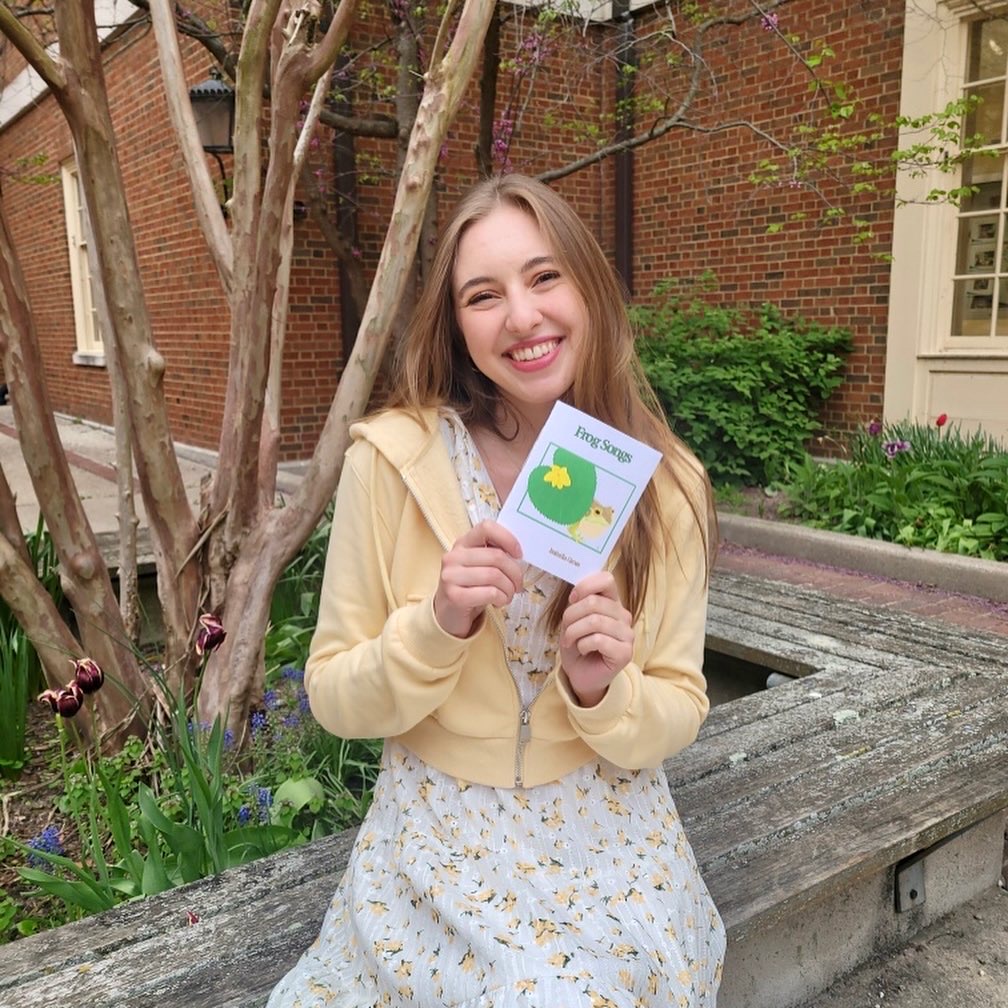
As all creative writers know, titling stuff really sucks. I went with “Frog Songs” because a good handful of the poems in the book referenced frogs and I thought it sounded cute. Some of my peers thought I was channeling Mary Oliver’s “Dog Songs,” which I was not, but I don’t mind that they share the same headspace for some people. And at the end of all this, I handed out my copies to my peers and in return received copies of their little books—now I have a collection of work from the poets I worked with my first year of my MFA at Miami University, and I thought that was really, really cool.
Me & my first “baby,” a little collection called “Frog Songs.”
In undergrad, I figured that I could break into that vague and daunting world of “publishing” with my English degree if I wanted to, if an handful of other things didn’t go my way. When you’re a curious and loud-mouthed English student like I was, you ask a lot of questions to your professors and visiting writers about publishing, like does publishing mean the writing part, editing part, the bookmaking part, or the marketing part? Do you get to pick whatyou do when you work in publishing and change it if you get bored? Do writers get to decide how they want the book to look? Do you have to live in New York City? To be honest, the answers were also fairly vague, which I guess contributes to that shroud of mystery that surrounds the publishing industry. From what I gathered, publishing is a profession with a high burnout rate; you mostly work in one department doing one thing and even though you could potentially move from one department to another, you’re still doing one thing at a time, be it editing, designing, or marketing; that writers don’t get hardly any say in how their books look, when they’re published, and what they get out of the deal; that all of this is more difficult considering my specialization is poetry; and that yeah, if you don’t want to work from your couch every day, New York is sort of the place to be. My general reaction to all of this was, um, that’s not exactly what I was hoping you’d say.
I started making books as a kid, like so many of us do. It’s all too easy to forget how easy and fun it is to write and draw and staple or tie the pages together and put it on the shelf, show it to your grandma. cris explained to us that they had started a press at nineteen publishing their friends’ work, and I was shocked. You mean, you can just publish people? Whatever work you like? By yourself? Turns out that the short answer is yes, you can do that. What I’m doing here is more complicated than making a book out of crayons and tape, but honestly, it’s even more fun.
And then, I asked a few more questions, did a little bit of internet research—& friends, here we are. Before you can make a website and an Instagram and put out a book, though, you gotta have a name. I had a nice little list going, but one stood out easily above the others:
The creative process, a series of ideas connected by, “And then I could try…”
Our best secrets and stories go, “And then…”
A poet and an artist, and then she tried making a little book.
Maybe it also speaks to the question I’m asking myself now, when the press is just getting going. A lifetime in school—a degree in English and then an MFA, and then what?
 And Then Publishing